

Inside the Engine: Why Compression Ratio Is F1’s Dark Art
By Woody Buchman

There are things in Formula 1 you can see.
Overtakes.
Pit stops.
Carbon fibre shattering at 300 km/h.
And then there are things you can’t see—
the ones that decide championships long before the lights go out.
Compression ratio lives in that world.
Quiet. Invisible. Ruthless.
The Pressure Before the Explosion
Inside every F1 engine, there’s a moment—fractions of a second—where everything is squeezed into almost nothing.
Air. Fuel. Heat. Pressure.
That’s compression.
And the higher you push it, the more violent the payoff when ignition hits.
Simple physics:
- More compression = more energy
- More energy = more power
- More power = lap time
But here’s the catch…
Push it too far, and the engine destroys itself.
Why It’s Called a “Dark Art”
Because nobody talks about it openly.
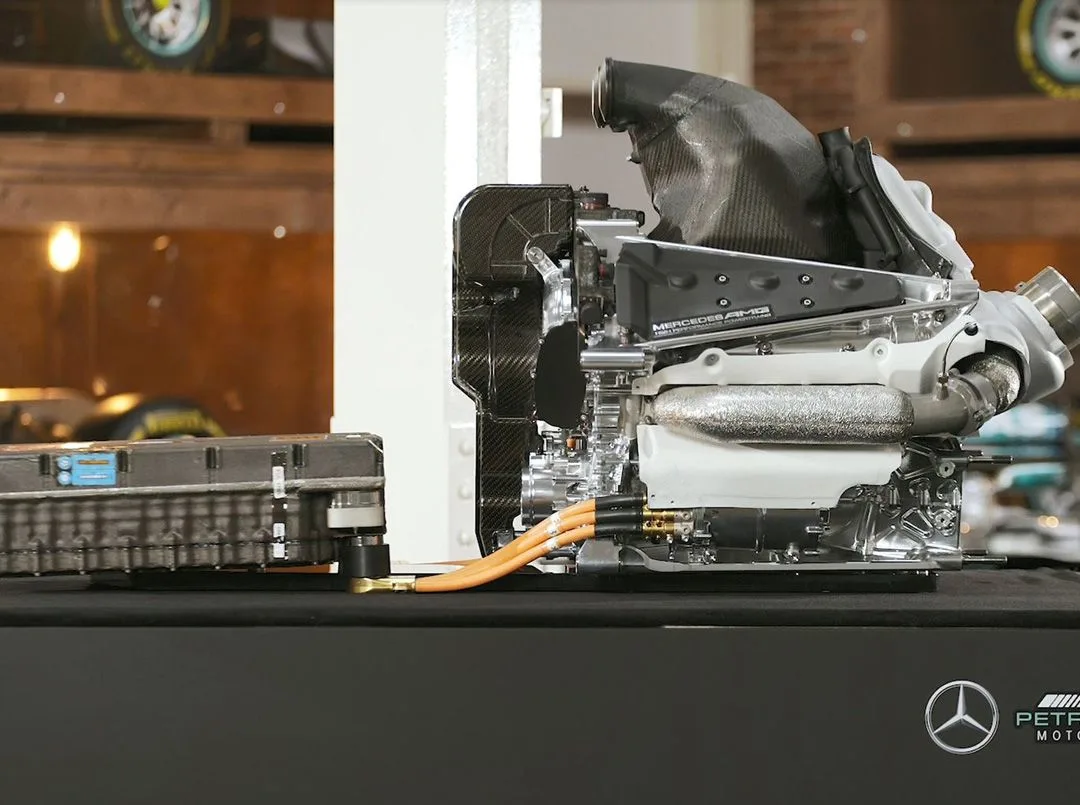
Not Mercedes-AMG High Performance Powertrains.
Not Scuderia Ferrari.
Not Red Bull Racing.
They won’t tell you:
- Their exact compression ratios
- How close they are to detonation
- How much risk they’re really taking
Because this is where races are won without anyone noticing why.
Fire Under Control


At extreme compression, combustion stops being smooth.
It becomes chaotic.
If it ignites too early?
You get knock—a violent shockwave inside the cylinder.
That’s how engines die.
So teams walk a knife edge:
- Maximum compression for performance
- Just enough control to avoid destruction
Mercedes has made a reputation living right on that edge… without falling off.
The Mercedes Philosophy: Precision Over Brute Force
Where others chase raw numbers, Mercedes chases stability at the limit.
Their advantage isn’t just high compression—it’s usable compression.
They achieve that through:
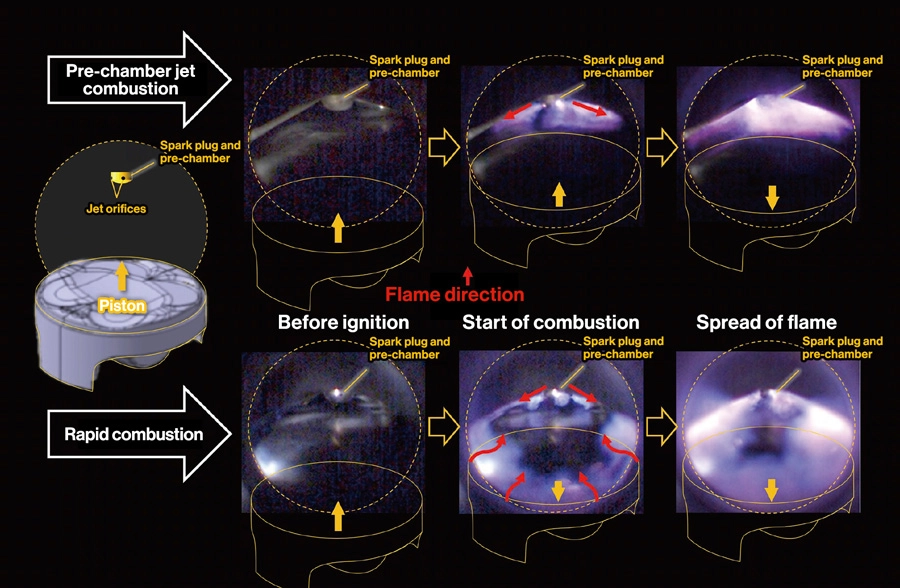
🔧 Pre-Chamber Ignition
A small, controlled explosion starts first—then ignites the main chamber.
- Faster burn
- Cleaner combustion
- More control at extreme pressure
🌡️ Thermal Mastery
Heat is the enemy of compression.
Mercedes manages temperatures so precisely that they can push harder, longer.
⚡ Hybrid Integration
The electric systems smooth everything out.
Instead of spikes in power… you get a wave.
And waves are easier to control than explosions.
What Rivals Are Chasing
Ferrari?
They’ve flirted with the edge—sometimes going over it.
Red Bull / Honda?
Incredibly powerful, but often described as knife-edge aggressive.
Both are fast.
But Mercedes is repeatable.
And repeatability wins championships.
The Invisible Advantage
You won’t see compression ratio on a timing screen.
You won’t hear it on commentary.
But you will see its effects:
- A car that pulls harder out of corners
- A driver who can trust the throttle
- An engine that doesn’t fade late in the race
That’s compression, working in the shadows.
Woody’s Take
Formula 1 isn’t just about speed.
It’s about controlled violence.
Compression ratio is the purest form of that—
taking something unstable, dangerous, and unpredictable…
…and mastering it.
Mercedes doesn’t just build engines.
They tame explosions.
And in a sport where everyone is chasing the limit,
the team that understands pressure the best…
usually breaks everyone else.


